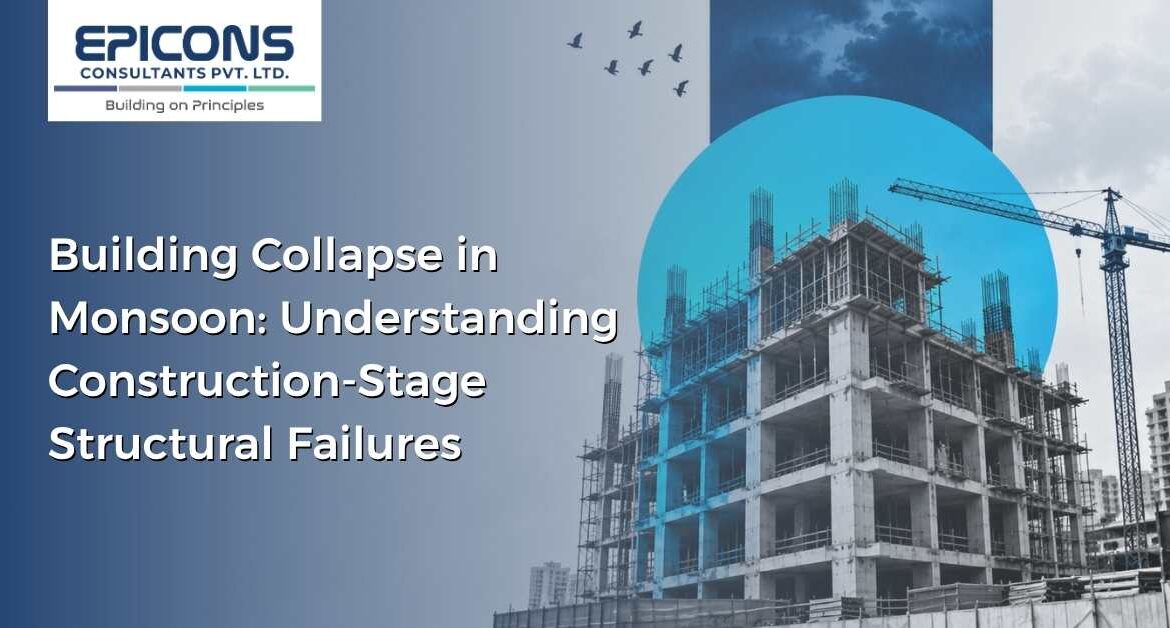
The monsoon season brings a recurring concern for the construction industry, particularly at sites where buildings are still under construction. Several incidents of partial or complete structural collapse during this period can be associated with construction-stage conditions, including shuttering, scaffolding, temporary supports, and changes in ground conditions caused by rainfall and groundwater. Understanding why these failures occur requires looking beyond the completed building design and examining the different stages through which a structure passes before it reaches its final form.
A completed building functions as an integrated structural system, with its foundations, columns, beams, slabs, and other structural members designed to work together under anticipated loads. The design process is governed by applicable regulatory codes and standards, and qualified structural engineers undertake the design and certification of the structure. This established framework provides several levels of technical review and accountability, reducing the possibility of structural failure after completion.
During construction, however, there can be multiple combinations of loads and their corresponding resisting systems. Typically, the final structural system is still evolving, and the permanent members and available structural elements in their current state may not yet be capable of supporting the loads that they will eventually carry. Temporary support systems therefore become essential to the construction process, ensuring structural safety at every stage.
Temporary support systems are among the most important arrangements used at a construction site. They support fresh concrete until it develops adequate strength, provide access and working platforms and, depending on their arrangement, may support construction activities and materials. These systems can be subjected to substantial loads, including fresh concrete, reinforcement, workers, stored materials and other site loads. Their stability depends on factors such as support spacing, bracing, connections, foundation conditions and the sequence in which construction takes place.
In specialized projects such as bridges, silos and large infrastructure structures, formwork and temporary support arrangements are generally designed specifically for the intended application. In regular residential construction, however, these arrangements may sometimes be based primarily on the judgement of skilled labourers. While practical knowledge is valuable, temporary works involving significant structural loads require engineering assessment as well. An arrangement that appears adequate under one set of conditions may behave differently when the loading, support condition or construction sequence changes. For that reason, temporary support arrangements should be suitably assessed for the intended construction stage and inspected by structural or senior site engineers before loading.
The monsoon introduces another important variable because rainfall can alter the condition of the ground supporting temporary structures. Geotechnical engineers understand that soil properties can change with variations in moisture content. Prolonged or intense rainfall can increase soil moisture, affect drainage and alter the behavior of certain soil types. These changes become particularly significant when temporary supports, props or access structures are placed directly on the ground, particularly where construction involves excavation.
Settlement of the supporting soil can alter the position and load distribution of temporary supports. If one support settles differently than others, the intended load distribution within the shuttering or scaffolding arrangement can change. This may introduce additional stresses into individual members and connections and, under unfavorable conditions, contribute to instability. The degree of risk varies according to soil type, groundwater conditions, drainage, excavation depth, rainfall intensity and the existing condition of the site, making the assessment inherently site-specific.
Deep excavation requires particular care during the monsoon, and most of the monsoon failures are related to failures of temporary support systems used to support the slopes formed due to deep excavation. Water entering an excavation can alter surrounding soil conditions and affect the stability of excavation sides. Accumulated water can also create difficulties for temporary support systems and access within the site. Where project planning permits, deep excavation in unstable soil should preferably be avoided during periods of heavy rainfall. Where such work is essential, geotechnical assessment, suitable excavation support and proper drainage arrangements become particularly important.
The same principle applies to the wider construction process. Temporary works should be considered as part of the engineering requirements of a project rather than as arrangements that can be addressed solely through site experience. Shuttering, scaffolding and temporary supports require assessment according to the loads they are expected to resist. Ground conditions should be reviewed where settlement or instability may occur, while excavations require suitable support and drainage. After heavy rainfall, temporary structures and their supporting ground should also be inspected before construction activities resume.
Along with proper design of temporary structures, the design process also involves the design of permanent structural members for temporary conditions during monsoon. Particular attention must be given for possible criticality due to increased earth and water pressures which can crack and/or displace the structural elements, not adequately designed for the staged construction process, introducing permanent distress or deformations or causing failure.
Coordination between structural engineers, geotechnical engineers and site teams is essential. Structural design consultants establish the requirements of the permanent structure, while Project Management Consultancy supports coordination, construction sequencing and site-level technical oversight. Where any structure under construction has sustained distress or damage due to any loads, structural assessment and non-destructive testing can provide technical information regarding its condition and assist in determining requirements for rehabilitation.
A multidisciplinary approach has particular value in projects involving different structural conditions and stages of construction. EPICONS Consultants, with over four decades of experience, has worked across structural design consultancy, project management consultancy, structural assessment and NDT, rehabilitation consultancy and infrastructure design, providing engineering services across a wide range of structural requirements.
The monsoon itself does not cause any structural damage. However, rainfall can expose weaknesses in temporary support systems, stability of permanent structural members for the particular stage of construction, ground conditions, excavation arrangements or construction practices that may already be vulnerable. Treating these factors as part of the engineering process allows potential risks to be assessed before they become critical. A structure under construction requires careful engineering at every stage, because the temporary conditions supporting its development can be as important to safety as the permanent structure it will eventually become.
For more information: bde@epicons.com | Connect: (022) 41006216 / 44500821