Buildings are designed to resist loads, but their response to movement is equally important. Earthquakes, wind, occupant activity and equipment can introduce movement and vibration that require carefully considered control strategies. As structural requirements become increasingly demanding, engineers are looking at technologies that can help manage these responses while supporting safety, usability and occupant comfort.
This is where energy dissipation and motion control become relevant. Seismic dampers and active mass dampers address different forms of structural movement, with each based on a different method of controlling response.
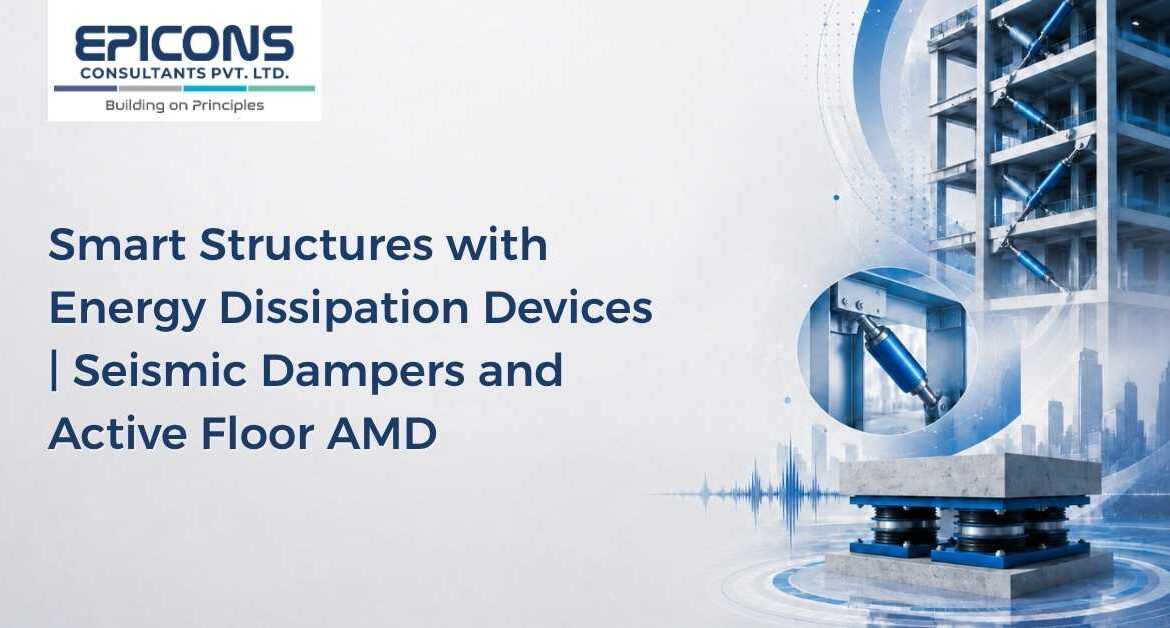
Seismic dampers work by absorbing and dissipating energy generated during structural movement. Fluid viscous dampers, for example, use fluid resistance to dissipate energy and can be integrated within structural frames. Depending on the application, dampers can be incorporated into braced frames, structural walls or other parts of a building where control of dynamic response is required. Traditional passive dampers operate without an external power supply, making them a practical component within seismic protection strategies.
Active Mass Dampers (AMD) work through a different mechanism. Sensors monitor structural acceleration and a control system processes this information in real time. Electric motors then shift a controlled mass to generate an opposing response. This makes AMD particularly relevant to vibration control, including floor vibration caused by occupant activity or equipment.
These technologies formed the central theme of Epicons Friends of Concrete (EFC) Webinar 152, “Smart Structures with Energy Dissipation Devices (Seismic Dampers and Active Floor AMD),” held on August 8, 2026. The four hour practitioner focused programme brought together Dr. Nathan Canney of Taylor Devices Inc., USA, Dr. Paul Reynolds of Calmfloor, and Er. Sandeep Shah of Miyamoto International, India to discuss seismic dampers, Active Mass Dampers, performance based design and practical structural applications.
Dr. Nathan Canney addressed fluid viscous damper implementation, along with updates associated with ASCE 7-28 and ASCE 41-29. His presentation placed seismic damping within the broader context of performance-based structural design, where the expected behaviour of a building under specified loading conditions becomes an important consideration.
While seismic dampers address structural response during events such as earthquakes, Dr. Paul Reynolds of Calmfloor presented Active Mass Dampers for a different requirement: controlling floor vibration. His presentation covered commercially available, volume produced AMD units capable of responding to vibration in real time.
The distinction between the two technologies is important. A seismic damper primarily dissipates energy introduced into the structural frame, while an AMD actively responds to measured vibration through controlled movement of a mass. Active floor technologies can target specific vibration frequencies, making them relevant to occupied spaces where foot traffic, equipment or other activities can create unwanted vertical floor vibration.
The webinar also brought the discussion into the Indian context through Er. Sandeep Shah of Miyamoto International, India, who presented applications involving several prominent structures. His presentation included the seismic upgrade of New Udaan Bhawan in Delhi, Chhatrapati Shivaji Maharaj International Airport Terminal T2 in Mumbai, the Air Traffic Control Tower at Delhi Airport and the seismic upgrade of Apollo Hospital in Delhi.
These examples provided a practical context for understanding where motion control technologies can become part of structural design and upgrading strategies. They also demonstrated the range of requirements that engineers may encounter, whether addressing seismic response in a new structure, improving an existing building, or controlling vibration within an occupied space.
The EFC Webinar 152 centered on an important aspect of contemporary structural practice, understanding how a building responds under dynamic conditions and selecting appropriate approaches to manage that response.
For structural professionals and architects, energy dissipation devices offer another set of tools for addressing seismic movement and vibration. Seismic dampers, fluid viscous dampers, and active mass dampers each have their own applications, design considerations, and operating principles.
The webinar brought these technologies together with performance based design, code developments and Indian case studies, providing practitioners with a practical view of how motion control technologies are being applied across different building requirements.
For EPICONS, such technical programs form part of a wider effort to bring current technical knowledge, practical experience, and emerging technologies into the professional community. Its work across structural design, assessment, rehabilitation, strengthening, and specialized services provides a wider context for understanding how new approaches can be evaluated and applied to real building requirements.
Smart Structures with Energy Dissipation Devices (Seismic Dampers and Active Floor AMD) points towards an important area of contemporary practice, where seismic protection, floor vibration control, performance based design and advanced technologies can contribute to buildings that respond better to the conditions they encounter. As requirements evolve, continued technical learning and knowledge sharing will remain important in evaluating these approaches and their place in future building design.
Marking MSME (Micro, Small and Medium Enterprises) Day 2026 on 27th June, the United Nations has laid the question directly on the table. The United Nations’ theme for the year, ‘Empowering MSMEs through Innovation and Sustainable Industrial Development’, is not really about gadgets or apps. It’s asking for something tougher. It must know whether the warehouses, the plants, the supporting infrastructure, the buildings that are going up are being built in a way that will still make sense 30 years from the present moment.
It’s a huge challenge. An estimated 79% of global greenhouse gas emissions and almost 88% of climate adaptation costs are linked to the built environment. Buildings and construction are responsible for around 37% of global emissions. The figures explain why sustainability plays a bigger role than just the environmental debate. It has become an engineering priority. (Source: UNEP)
Every tonne of steel, every cubic metre of concrete, every construction activity adds to the environmental footprint of a project. Consequently, structural systems are being evaluated for ways to maximise performance while minimising material consumption.
One measure of sustainability rarely shares headlines with solar panels or electric cars, but it is just as important. Instead of tearing down an old building, rehabilitation and retrofitting can give it new life while avoiding the environmental costs of demolition and rebuilding. Buildings are restored, allowing them to remain useful for decades longer while saving materials, energy and capital.
What goes into the concrete mix is as important as what happens to the building afterward. Fly ash and Ground Granulated Blast Furnace Slag are appearing on more job sites these days, mainly because they lower carbon emissions while still providing structural strength. Careful planning and sensible use of materials, with less waste left behind on site, makes the whole build look a lot more responsible by the time it’s finished.
Critical support systems also have to be in the spotlight of sustainable development. Wastewater treatment plants, sewage treatment systems, utility networks and resilient public assets are essential for ensuring expansion is compatible with environmental responsibilities. Production facilities aside, there’s long-term environmental stewardship.
At EPICONS Consultants Pvt. Ltd., these principles are applied through efficient structural systems, material optimisation, rehabilitation strategies and climate-responsive engineering solutions. The organisation also encourages responsible material usage through digital documentation, regulated paper consumption, water conservation measures, energy-conscious practices and community transportation initiatives that help reduce fuel consumption.
Technical education and professional learning represent another vital element within this broader change. Through the Epicons Friends of Concrete (EFC) platform and various educational initiatives, professionals gain access to technical learning opportunities focused on structural assessment, rehabilitation methodologies and responsible construction practices.
A surprising amount of environmental impact is determined before construction begins, at the stage where material and design decisions are made. The materials selected, the structural systems adopted, the intended service life of an asset and the decision to rehabilitate rather than replace all influence its environmental footprint. Together, these choices create a legacy that outlives the lifespan of any individual project.
Smaller manufacturers share this responsibility. MSMEs are rapidly adopting emerging technologies and pursuing greater competitiveness in increasingly dynamic markets.
However, construction decisions will often outlast multiple generations of equipment upgrades. Thoughtful planning, efficient resource utilisation and responsible engineering practices therefore become essential in ensuring economic progress remains aligned alongside environmental stewardship. Perhaps the strongest foundations for future progress may well be those built through durability, conservation and responsible material choices today.
For more information: bde@epicons.com | Connect: (022) 41006216 / 44500821