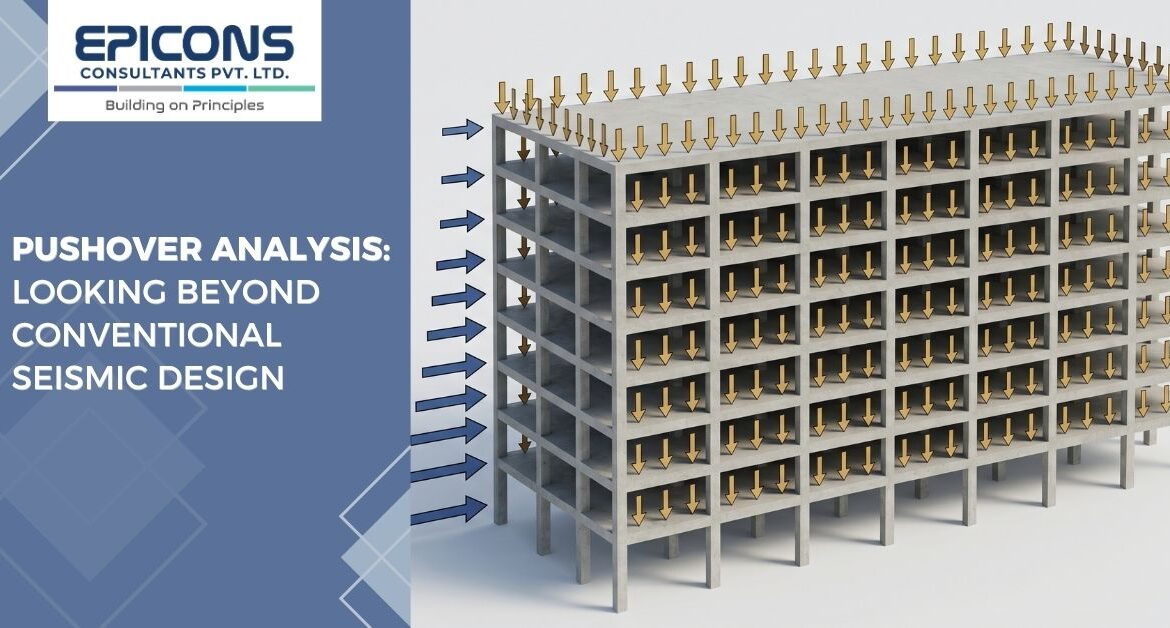
At present, most practicing structural designers design buildings in compliance with the provisions of prevailing IS Codes. The standard approach involves linear static and linear dynamic analysis, predominantly using the Response Spectrum Method, which is generally considered adequate for assessing both the elastic and ductile response of a structure.
However, elastic analysis has inherent limitations. It cannot capture the redistribution of internal actions resulting from progressive yielding, nor can it accurately predict failure mechanisms or identify potential locations of premature structural distress. A Non-linear Static Analysis, commonly known as Pushover Analysis, offers a significantly better understanding of such behaviour by incorporating the inelastic characteristics of the structure.
In conventional linear analysis, the fundamental time period is assumed to remain constant throughout the analysis. In Pushover Analysis, however, the structural properties are continuously updated as the analysis progresses and stiffness degradation occurs. The inelastic behavior is represented through non-linear hinges introduced into an otherwise linear elastic model generated using commonly available structural analysis software such as ETABS, SAP2000, STAAD.Pro, and similar platforms equipped with pushover analysis capabilities.
The methodology for conducting Pushover Analysis can be learned through industry practitioners, academic institutions such as the IITs, and extensive national and international technical literature. During the analysis, the sequence and progression of structural damage can be monitored through the development of hinge states at various locations within the structure.
At the conclusion of the analysis, a Performance Point is established where the structural capacity intersects the seismic demand. This point provides valuable insight into the expected seismic permormance of the structure. The hinges are categorized into different limit states, namely Immediate Occupancy (IO), Life Safety (LS), and Collapse Prevention (CP). The overall structural response is represented through a Base Shear versus Roof Displacement curve. Depending upon the location of the Performance Point on this curve, the expected condition of the structure during a seismic event can be assessed in terms of IO, LS, or CP criteria.
The foundation of conventional seismic design lies in the use of the Response Reduction Factor (R). A specified value of R is introduced in the denominator during seismic force calculations, thereby reducing the design seismic demand. When discussing Performance-Based Design, however, the objective is to evaluate the structural response under the Maximum Considered Earthquake (MCE), effectively implying an R value of 1.
This immediately highlights a significant distinction. If the reduction permitted through the Response Reduction Factor is eliminated while retaining similar ductility expectations, the structure must possess substantially higher lateral strength. This may result in increased member sizes, reinforcement quantities, and consequently higher construction costs.
In practical applications, Pushover Analysis is particularly useful for two categories of structures. The first involves evaluating the adequacy of existing or ageing structures, while the second pertains to the design of new structures.
For existing structures, the analysis may reveal that the Performance Point falls within the Collapse Prevention range or even indicates inadequate seismic capacity. In such situations, suitable retrofitting measures can be proposed and incorporated into the analytical model. Subsequent iterations can then be carried out until the desired seismic objective, typically Life Safety or Immediate Occupancy, is achieved. Therefore, the value of Non-linear Static Analysis for existing structures is well established and readily understood.
The question that frequently arises is whether Pushover Analysis has practical relevance for greenfield developments and newly designed structures. The answer largely depends upon the nature and importance of the facility. Most clients remain focused on material quantities and overall project economics. Consequently, widespread adoption may initially be limited to critical infrastructure such as healthcare facilities, government buildings, research establishments, defence installations, parliamentary complexes, and national heritage structures.
Nevertheless, if structural engineers can demonstrate that a building can achieve at least a Life Safety objective, and preferably an Immediate Occupancy objective, without substantial impact on project economics, the perception of Pushover Analysis and Performance-Based Design may gradually evolve within the industry.
Looking ahead, the engineering fraternity has an important role in addressing challenges associated with climate change. This includes exploring structural systems utilizing alternative low-carbon materials while maintaining the required strength, serviceability, and durability requirements. Equally important is the intelligent application of Value Engineering to achieve technically sound and economically viable solutions. These aspects will be discussed in subsequent articles.
With suitable regulatory support, industry participation, continued research, and growing market acceptance, Performance-Based Design supported by Pushover Analysis has the potential to become an increasingly important component of structural engineering practice in India and internationally.
For more details and expert structural engineering consultancy, visit: www.epicons.co.in
Suhas Balasaheb Jadhav
Deputy General Manager- Design | Structural design Unit- III
(Epicons Consultancy Pvt. Ltd.)