Structural engineering rarely becomes visible when everything functions exactly as planned. When a bridge remains stable under constant dynamic loading, when a hospital remains operational after seismic activity, or when a metro system maintains functionality during ground movement, the engineering behind that stability often receives little public attention. Yet every structural failure immediately exposes how critical early-stage engineering decisions become when buildings and infrastructure face real seismic stress.
Earthquake-resistant design, therefore, involves far deeper engineering consideration than simply increasing structural strength or adding larger structural members. Modern infrastructure systems today are becoming taller, more irregular, more interconnected and significantly more demanding in terms of operational safety. Airports, healthcare facilities, industrial plants, transportation hubs, mixed-use towers and large public structures each introduce highly complex loading behaviour, vibration challenges and structural-response conditions that conventional design approaches alone may struggle to address efficiently.
One of the most important engineering challenges in seismic design is understanding how a structure behaves once earthquake energy enters the system. During seismic activity, buildings experience rapid lateral movement, torsional effects, vibration amplification and dynamic load redistribution. In structures involving irregular geometry, varying mass distribution, transfer floors, floating sections or large-span architectural layouts, these responses become even more difficult to predict and control. Structural engineers today therefore rely increasingly on advanced analytical methods and innovative seismic systems capable of managing seismic forces with greater efficiency and reduced structural damage.
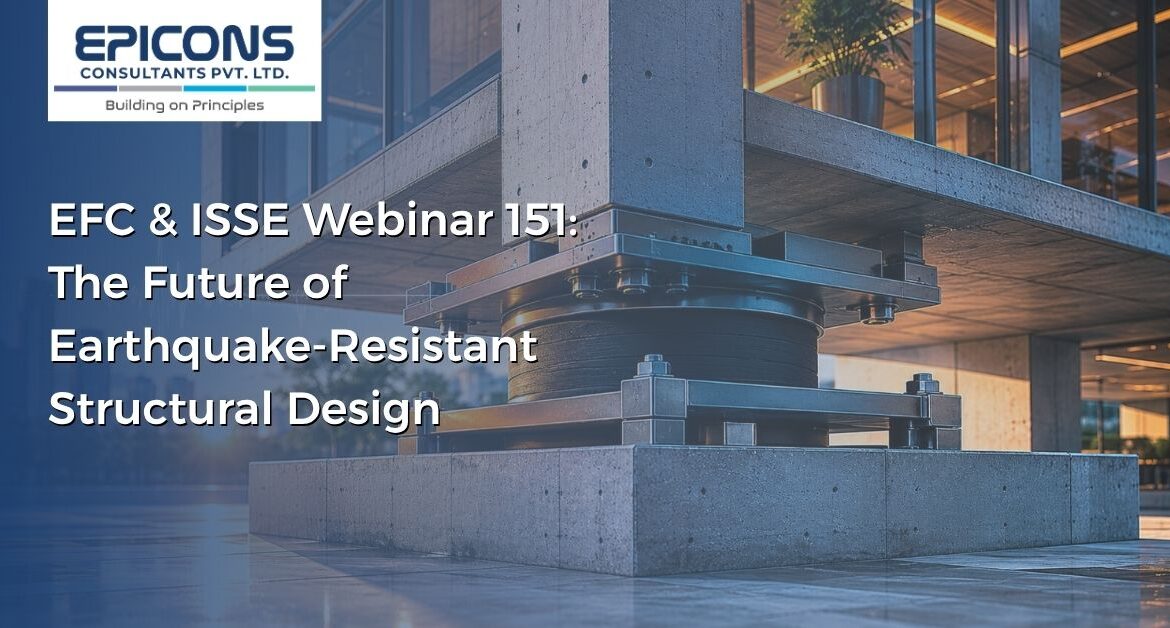
Bringing focus to these engineering realities, Epicons Friends of Concrete, the technical knowledge platform of Epicons Consultants Pvt. Ltd., in association with the Indian Society of Structural Engineers (ISSE), will conduct Webinar 151 titled “Complex Structures and Innovative Solutions: Base Isolators for Earthquake-Resistant Design” on Saturday, 6th June 2026 between 10:00 AM and 1:00 PM through Zoom.
The webinar is structured around practical seismic engineering applications connected with modern infrastructure requirements. Rather than remaining limited to broad theoretical overviews, the technical sessions will focus on how advanced seismic systems are being applied across real project environments involving complex structures and critical infrastructure.
One of the important areas expected to receive detailed technical attention during the webinar is base isolation technology. Base isolators function by reducing the transfer of earthquake-generated motion into the building superstructure.
Instead of forcing the structure to absorb the complete intensity of seismic acceleration, these systems help control vibration levels and lower structural stress during seismic activity. This approach significantly improves the ability of structures to maintain stability and operational functionality during and after earthquakes.
The growing application of base isolation systems across hospitals, emergency-response facilities, airports, industrial facilities and transportation infrastructure highlights how seismic engineering today increasingly focuses on operational safety alongside structural protection. In many modern infrastructure systems, keeping the facility functional after seismic activity becomes equally important as preventing structural collapse.
The webinar will also cover nonlinear structural analysis, soil-structure interaction and energy-dissipation systems used within modern seismic engineering practice. These methods help engineers understand how structures actually behave under real earthquake loading conditions rather than relying entirely on simplified design assumptions. Such engineering approaches become particularly important in structures involving asymmetrical layouts, varying stiffness distribution and architecturally ambitious configurations where seismic response becomes highly complex.
Another key aspect within modern seismic engineering is the growing relationship between architecture and structural behaviour. Contemporary buildings frequently involve open-plan spaces, vertical irregularities, mixed structural systems and visually ambitious forms that require highly sophisticated seismic evaluation. Engineers must therefore balance structural efficiency, architectural requirements, safety expectations and operational functionality simultaneously within increasingly demanding infrastructure environments.